Table of Contents
Trading Card Game Rules: A Complete Breakdown of a Full Monquest Match

Trading card game rules can seem intimidating when you’re learning a brand-new game. That’s exactly why I recorded a complete physical match of Monquest, where I explain every major mechanic while playing an actual game from beginning to end.
Instead of only reading a rulebook, you’ll see these trading card game rules demonstrated exactly as they’re meant to be played. Every draw, summon, attack, status effect, and strategic decision happens naturally throughout the match, making it much easier to understand how all of Monquest’s mechanics work together.
Whether you’re a longtime trading card game player, someone interested in indie tabletop games, or simply curious about Monquest, this guide will walk you through the core systems that make every match feel strategic from the opening hand to the final Battle Point.
Watch the complete gameplay here:
Trading Card Game Rules: What Makes Monquest Different?
Every trading card game has its own identity.
When I designed Monquest, one of my biggest goals was making strategy more important than simply having the strongest monster on the field.
These trading card game rules were built around giving players meaningful choices every single turn.
Instead of controlling only one active creature, each player manages two active monsters at once. Throughout the match, players balance Attribute Cards, Equipment, Items, status effects, Battle Points, and multiple summoning systems while constantly adapting to what their opponent is doing.
Because there are so many possible decisions each turn, no two games play exactly the same.
Trading Card Game Rules: Setting Up a Match
Every game begins with each player drawing five cards.
Players secretly choose one or two legal starting monsters from their opening hand and place them face down before revealing them simultaneously.
Unlike many card games, these trading card game rules don’t randomly determine who goes first.
Instead, the monster with the highest Attack stat earns the choice of taking the first or second turn.
Each player begins the demo game with 200 Battle Points (BP).
Reducing your opponent’s Battle Points to zero wins the game.
Because Battle Points can be attacked directly under certain conditions, players must constantly decide whether eliminating monsters or pressuring Battle Points gives them the best chance to win.
Trading Card Game Rules: Understanding the Attribute Card System
One of the most unique trading card game rules in Monquest is the Attribute Card system.
Rather than placing resource cards into the main deck, every player maintains a separate Attribute Pool.
These Attribute Cards function similarly to mana or energy systems found in RPGs, allowing monsters to activate powerful abilities without reducing the consistency of the main deck.
Separating resources from the deck means players spend less time hoping to draw energy and more time making meaningful strategic decisions.
Managing Attribute Cards effectively often determines who wins close matches.
Trading Card Game Rules: Seven Status Effects Explained
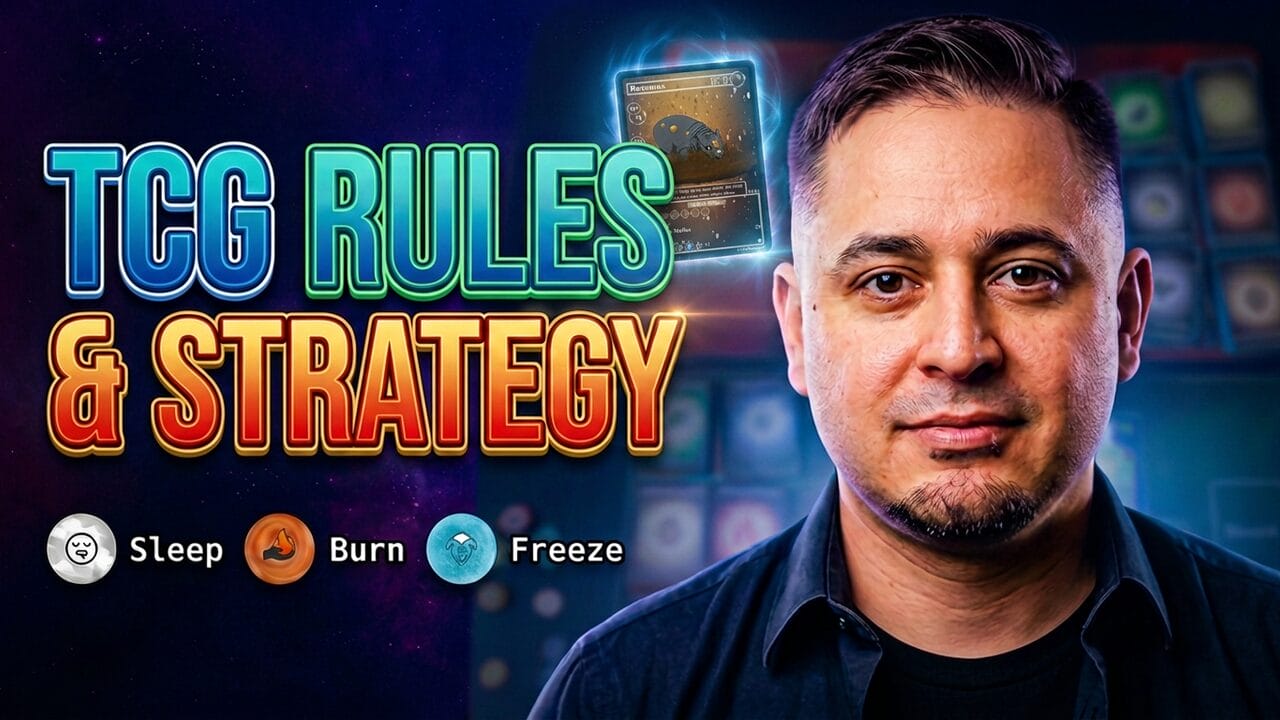
Among the most important trading card game rules are the game’s seven status effects.
Even lower-level monsters can completely disrupt stronger opponents by applying conditions that limit attacks, abilities, or battlefield control.
Burn
Burn immediately damages a monster and continues dealing damage over time until removed.
Poison
Poison steadily drains HP every player’s turn, forcing difficult decisions about whether curing the status is worth sacrificing momentum.
Confusion
Confusion introduces risk into every damaging attack or ability.
Failed coin flips cause monsters to damage themselves instead of executing their intended action.
Blind
Blind requires successful coin flips before attacks or damaging abilities can connect.
Sleep
Sleeping monsters must wake successfully before performing many actions.
Frozen
Frozen monsters cannot perform monster actions until the status is removed.
Paralysis
Paralyzed monsters are also unable to perform monster actions, making Paralysis one of the strongest forms of battlefield control.
These trading card game rules ensure that status effects remain relevant from the opening turn until the very end of every match.
Trading Card Game Rules: Level Summoning, Form Summoning, and Equipment
One of the most strategic trading card game rules is how monsters grow stronger during a match.
Monquest offers three different progression systems, each encouraging different styles of play.
Level Summoning
Level Summoning allows players to replace lower-level monsters with stronger monsters that meet the proper summoning requirements.
Choosing when to Level Summon is often just as important as deciding which monster to summon.
Waiting too long may leave stronger monsters stuck in your hand.
Summoning too early may remove useful abilities currently helping your strategy.
Form Summoning
Form Summoning follows a completely different path.
Instead of instantly replacing a monster, Form monsters evolve through connected stages over multiple turns.
A Stage 1 Form monster must survive for one turn before advancing into Stage 2.
Stage 2 must then remain on the battlefield for two additional turns before reaching its final Stage 3 Form.
Because opponents can interrupt this process, Form Summoning rewards careful planning and protecting your monsters over several turns.
Equipment Summoning and Equipment Upgrades
Equipment introduces another layer of progression.
Certain monsters can transform through Equipment Summoning using a specific Equipment card.
If that Equipment is destroyed, the monster immediately returns to its original form.
Other Equipment cards improve monsters through upgrades that unlock stronger passive bonuses over time.
Together, these trading card game rules create multiple ways for players to develop their battlefield instead of relying on only one progression system.
Trading Card Game Rules: Recovery and Comeback Mechanics
Another unique part of Monquest’s trading card game rules is the Recovery system.
If every monster on your battlefield is defeated, the game doesn’t immediately end.
Instead, players enter a Recovery Phase where they must rebuild their field by drawing into legal monsters or making important decisions involving Battle Points and card management.
These trading card game rules help prevent one unlucky turn from instantly ending an otherwise competitive match.
Trading Card Game Rules: Why Strategy Beats Raw Power
One of my biggest goals while designing these trading card game rules was making sure every monster stayed useful throughout an entire game.
Many trading card games eventually become dominated by their biggest creatures.
Monquest intentionally takes a different approach.
Lower-level monsters continue influencing the battlefield through status effects, utility abilities, direct Battle Point attacks, and tactical support.
The featured match demonstrates this perfectly.
Although one player builds an impressive field with stronger monsters, the opposing player fights back using status effects like Confusion and Blind, carefully timed Item cards, and smart Battle Point management before ultimately securing the victory.
Those moments are exactly why I designed these trading card game rules around decision-making rather than raw numbers.
Trading Card Game Rules: Watch the Complete Match
If you’d like to see these trading card game rules demonstrated in a real game, I invite you to watch the complete Monquest match.
The video covers:
- Complete game setup
- Opening hand decisions
- Battle Points
- Attribute Cards
- Level Summoning
- Form Summoning
- Equipment
- Status effects
- Recovery
- Tactical gameplay
- The complete match from start to finish
You can watch the full gameplay here:
Final Thoughts
Creating Monquest has been a long journey, and recording this complete match marks an exciting milestone in its development.
These trading card game rules were designed to create close, competitive battles where every decision matters. Whether you’re deciding when to summon, managing Attribute Cards, protecting a Form monster, upgrading Equipment, or choosing between attacking monsters and Battle Points, every action can influence the outcome of the game.
I hope this guide and the accompanying gameplay video make learning Monquest easier while giving you a look at the design philosophy behind the game.
If you watch the match, I’d love to hear what mechanics stand out to you the most. Your feedback helps shape the future of Monquest as I continue developing both the physical trading card game and its digital adaptation in Unity. version evolve.
Monquest new cards are now available to view online, and this update is another major step toward bringing the game to more players.
Discover more Monquest here
Leave a Reply