Monquest Playtesting Begins: 7 Major Gameplay Updates Improving Balance and Flow
Table of Contents
Why Monquest Playtesting Matters
Monquest playtesting is one of the most important stages of development. This phase allows real matches and real decision-making to shape the final gameplay experience.
Playtesting helps:
- Identify balance issues
- Improve pacing and flow
- Remove stalled gameplay situations
- Refine mechanics for competitive play
- Prepare the game for expansion and digital development
Every match played during monquest playtesting provides insight into how mechanics function in real scenarios rather than theory alone.
This process ensures that Monquest evolves into a polished and strategic trading card game rather than remaining a static prototype.
What Has Changed in Monquest
The newest version of Monquest includes a full rulebook overhaul and major system refinements. These changes were implemented to improve clarity, balance, and overall gameplay pacing.
The updated official rulebook now includes:
- Reorganized mechanics and terminology
- Clearer rule structure
- Updated gameplay flow explanations
- Balance adjustments based on live testing
- Integrated clarifications for items, abilities, and battle rules
The rulebook is now implemented directly into the testing build, allowing players to reference mechanics instantly during matches.
Core Gameplay Balance Updates
Defense System Overhaul
One of the most important changes introduced during monquest playtesting is the new defense system.
Defense now functions as a true damage gate:
- If ATK is less than or equal to DEF, damage dealt becomes zero.
- This prevents weak chip damage from slowly draining stronger units.
- Defensive strategy becomes more meaningful and impactful.
This change creates clearer power differences between Mons and encourages smarter combat decisions rather than repetitive low-damage attacks.
Direct Battle Point Attacks
To prevent stalled matches when fields become empty, direct battle point attacks have been introduced.
If a player controls no Mons:
- Opponent may attack battle points directly
- Each active Mon deals 20 battle points damage
This system keeps matches moving forward and ensures that players cannot stall indefinitely without field presence.
New Anti-Stall and Flow Systems
Hand Recovery System
During monquest playtesting, a new anti-stall draw system was introduced to prevent players from becoming stuck with unusable hands.
If a player cannot play a Mon:
- They may discard one card to draw one
- Or lose 10 battle points to draw one
- This repeats until a playable Mon is drawn
If a player has zero cards:
- Immediately draw five cards
This keeps both players active and prevents dead turns that slow gameplay.
Level Summoning Flow Update
Level summoning can now chain immediately without waiting a turn between evolutions. This allows players to:
- Build combo plays
- Strategically summon boss Mons
- Maintain gameplay momentum
The result is faster pacing and more dynamic turn sequences.
Item and Ability System Clarifications
Items have been streamlined for smoother gameplay:
- Items can be used freely during a player’s turn
- They do not require a Mon action phase
- Only items that explicitly state so will end an action phase
- Items may be used even without a Mon on the field
Destruction rules were also updated:
If a Mon is destroyed by an ability, item, or effect:
- It counts as a knockout
- Battle point loss applies normally
- The current action phase does not automatically end unless specified
These changes improve consistency and reduce confusion during matches.
Revive System Implementation
A new revive system has been added to improve strategic recovery options.
When a Mon is revived:
- The reviving Mon’s action phase ends
- The revived Mon gains its own action phase
- The revived Mon cannot deal battle point damage that turn
- Non-damaging abilities may still be used
This ensures revival remains powerful but balanced.
Deck Structure Rebalance
Monquest playtesting also introduced a recommended deck structure to improve consistency and pacing.
Recommended deck structure:
- 16–18 low-level Mons (1–40)
- 4–6 mid-tier Mons (41–70)
- 1 boss Mon maximum
- 13–15 item cards
- 5–6 equipment cards
- 44-card deck size
This structure creates smoother gameplay and better interaction between players throughout matches.
Tabletop Simulator Testing Environment
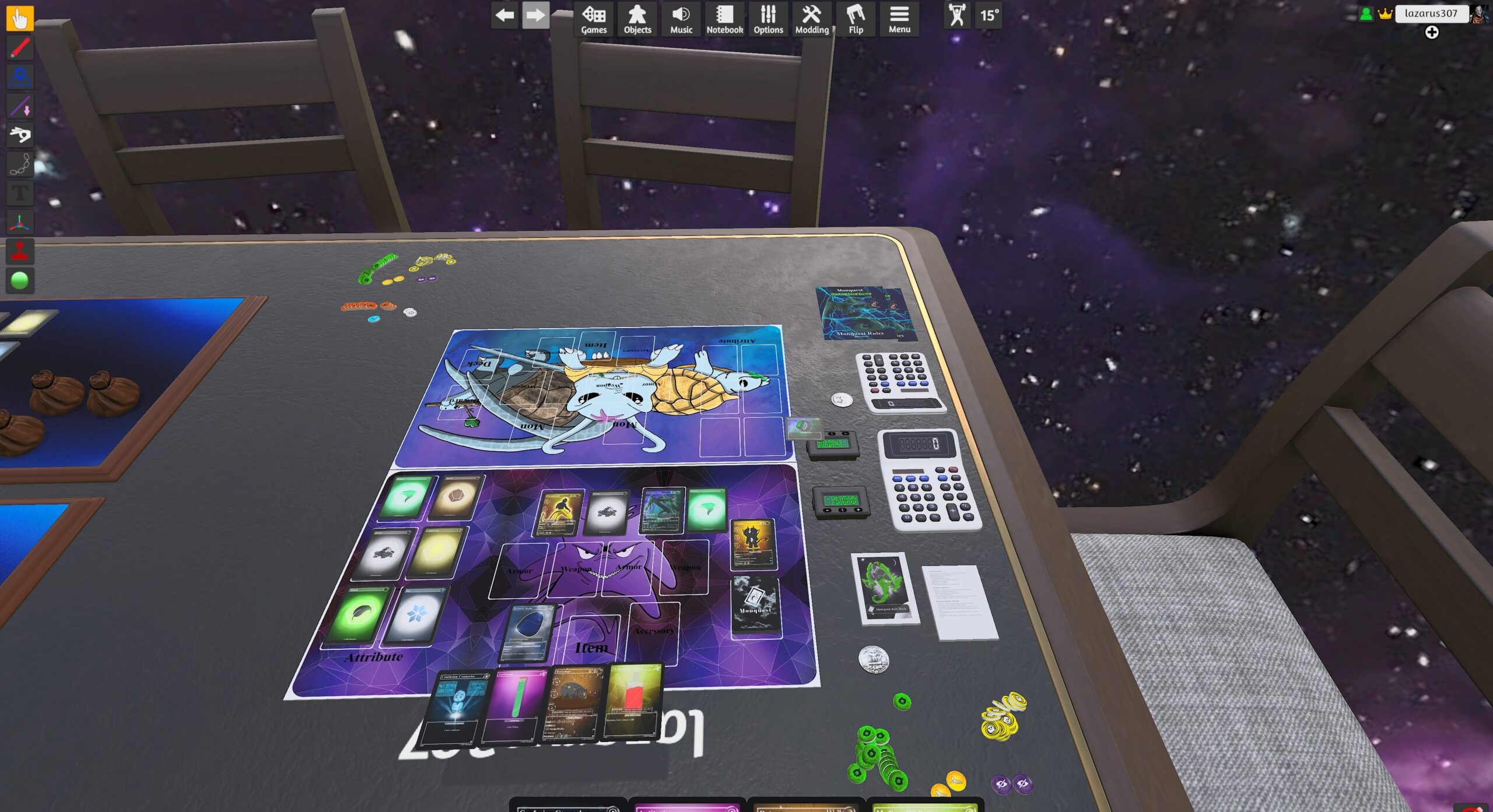
The current testing environment for monquest playtesting is being conducted through Tabletop Simulator.
The updated testing build includes:
- New playmat layout
- Organized card systems
- Starter decks placed for quick testing
- Updated rulebook integrated into the table
- Structured deckbuilding layout
This allows rapid testing and iteration while maintaining consistent rules and mechanics.
You can learn more about Tabletop Simulator here:
https://store.steampowered.com/app/286160/Tabletop_Simulator/
Tabletop Simulator provides a flexible environment for indie tabletop developers to test and refine gameplay systems before physical production.
What Comes Next for Monquest
The current phase of monquest playtesting focuses on:
- Balance validation
- Match pacing refinement
- Strategic depth improvements
- Preparation for future expansions
- Integration with digital game development
Monquest is designed to evolve into both a physical trading card game and a digital experience, including the upcoming video game project Monquest: Dimensions Unleashed.
Playtesting ensures both versions share a strong, balanced foundation.
How to Follow Monquest Development
You can follow ongoing monquest playtesting and development updates through the official website and community channels.
More updates will include:
- Gameplay refinements
- New card reveals
- Expansion mechanics
- Video game development previews
- Behind-the-scenes design insights
This is only the beginning of the next phase of Monquest’s evolution.


Discover more Monquest here

Leave a Reply